UNESCO lists Roman aqueducts and other ancient infrastructure among globally protected World Heritage sites. We often assume that precision is a modern invention, but the ancient world was full of master engineers. Without the aid of computers or power tools, they moved stones weighing hundreds of tons and aligned structures with astronomical accuracy. Join us as we explore ten of the most astounding engineering feats of the ancient world and the secrets behind their construction.
1. The Art of the Monolith
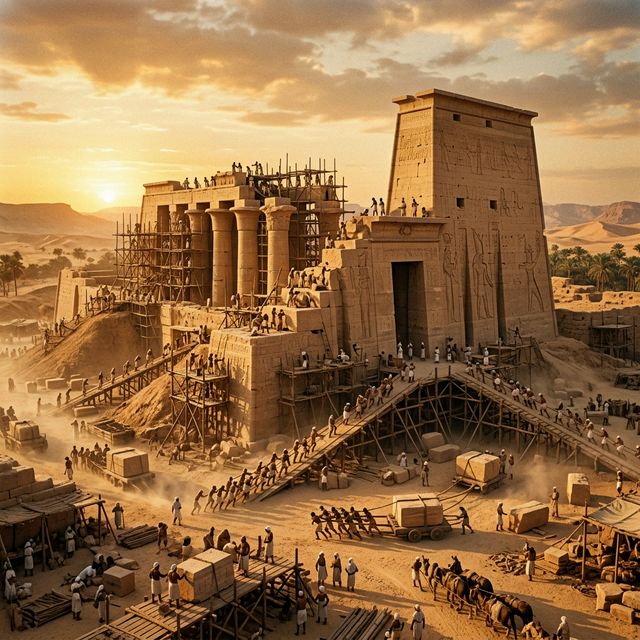
The ability to move massive stones across long distances remains one of the greatest feats of ancient civilization. Using a combination of lubricants, massive workforces, and brilliant leverage techniques, engineers in Egypt and Europe moved stones that would challenge even modern cranes. It was a victory of organization as much as engineering.
2. Precision in the Giza Plateau
The Great Pyramid of Giza is not just large; it is incredibly precise. Its base is level to within less than an inch, and its sides are aligned with the cardinal points of the compass with an error of only three-sixtieths of a degree. Achieving this level of accuracy required sophisticated surveying tools and an advanced understanding of geometry that predates modern mathematics by millennia.
3. The Antikythera Mechanism
Often called the world's first analog computer, the Antikythera Mechanism was found in a Greek shipwreck dating back to 100 BC. This complex device of bronze gears was used to predict astronomical positions and eclipses for calendar and astrological purposes decades in advance. The level of mechanical engineering found in this device would not be seen again for another thousand years.
4. The Moai of Easter Island

On a remote Pacific island, hundreds of giant stone statues stand as a testament to the ingenuity of the Rapa Nui people. Moving stones that weigh up to 86 tons over vast distances was a feat once thought to be impossible without specialized machinery. Modern experiments show that a "walking" technique using ropes could move the statues with relative ease, effectively showing that the Rapa Nui "made the statues walk."
5. The Aqueducts of Rome

Engineering didn’t just create monuments; it provided for the common good. Roman aqueducts managed to move water over hundreds of miles using nothing but gravity, with gradients as small as a few inches over a mile. These systems were so well-built that parts of them still function today, nearly 2,000 years later, fueling the fountains of Rome with fresh spring water.
6. Petra: The City in the Rock
In the Jordanian desert, the Nabataeans carved an entire city directly into the sandstone cliffs. Their engineering prowess wasn't just aesthetic; they developed complex water management systems that allowed a thriving city to exist in a parched desert. Petra's buildings are marvels of both subtractive architecture and hydraulic engineering.
7. The Incan Stones of Cusco
The Incan walls of Cusco, Peru, feature massive stones fitted together so precisely that a piece of paper cannot be inserted between them. This was achieved without the use of mortar, using a technique called "ashlar masonry." The irregular shapes of the stones actually make the structures more earthquake-resistant, a necessity in the seismic Andes.
8. The Terracotta Army
The First Emperor of China didn't just build a tomb; he built a subterranean city guarded by over 8,000 one-of-a-kind stone soldiers. The precision of their weaponry, the unique facial features of each figure, and the sophisticated bronze metallurgy highlight a standard of mass production that would be considered impressive even in the modern age.
9. The Pantheon's Dome
Rome's Pantheon remains the largest unreinforced concrete dome in the world, nearly 2,000 years after it was completed. To achieve this, Roman engineers used increasingly lighter materials as the dome reached its peak, and designed the oculus to relieve the weight of the structure's center. It is a masterpiece of material science and architectural design.
10. Stonehenge: The Original Calendar
Stonehenge is far more than a collection of large rocks. Its stones are perfectly aligned with the summer and winter solstices, functioning as a massive astronomical observatory. The transport of the "bluestones" from over 150 miles away and their precise arrangement show that prehistoric Britons possessed sophisticated logistical and celestial knowledge.
FeexHub's Take
At FeexHub, we believe that the "wonders" of the ancient world isn't just their size; it's the creative problem-solving our ancestors used to overcome impossible odds. Every time we research their methods, we learn that ingenuity isn't a modern invention. These structures stand today as reminders that with a common vision and enough persistence, humanity can quite literally move mountains. Building for eternity is a mindset we should strive for even today!