Primary sources preserved by the U.S. National Archives help separate documented events from popular myths. History is often written by the victors, and in the process, some of the most fascinating details get swept under the rug. Beyond the dates of famous battles and the names of kings lie stories of accidental inventions, secret codes, and bizarre coincidences that shaped our modern world. Here are ten hidden chapters of history that deserve a second look and will change how you see the past.
1. The Library That Time Forgot

While the Library of Alexandria is famous for its loss, there have been others that were hidden away for centuries only to be rediscovered by chance. Secret archives in remote monasteries have yielded texts that rewrote our understanding of early mathematics and philosophy. Some of these scrolls weren't rediscovered until the 20th century, hidden behind false walls during times of war.
These "lost" libraries remind us that our knowledge of the past is always evolving. Every new discovery of an ancient text acts as a bridge to a world we thought was gone forever. The preservation of these secrets was often a matter of survival, not just for the monks who guarded them, but for the information itself.
2. The Witty Warriors of the Past

We often think of ancient warriors as grim and humorless, but history tells a different story. From the sarcastic replies of Spartan generals to the intricate wordplay of Viking skalds, wit was often considered as important as strength. In fact, some of the most famous diplomatic exchanges in history were won with a single, cutting remark rather than an army.
These stories show a human side to history that is rarely taught. They remind us that the people of the past were remarkably like us - capable of irony, humor, and sharp observation even in the direst of circumstances. Developing a "silver tongue" was once an essential part of a leader's training.
3. The Secret Behind the Pyramids' Brilliance
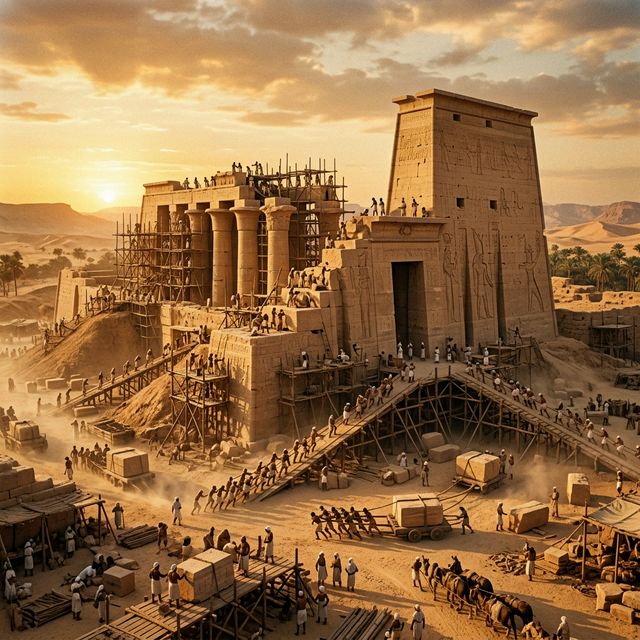
Originally, the Great Pyramids of Giza didn't look like the weathered stone structures we see today. They were covered in highly polished white limestone casing stones that reflected the sun so brightly they were said to shine like jewels. You could likely see them from miles away, acting as a true beacon of the Pharaoh's power.
Most of these casing stones were removed over centuries to be used for building mosques and palaces in Cairo. Only at the very peak of the Pyramid of Khafre can you still see a remnant of what this original surface looked like. It's a reminder that even the most permanent monuments are subject to the slow theft of time.
4. The Antikythera Mechanism
Discovered in a shipwreck in 1901, this complex mechanical device is often called the world's first analog computer. Dated to around 100 BCE, it could predict astronomical positions and eclipses with startling accuracy—technology that disappeared and wasn't seen again for over a thousand years. It remains a haunting reminder of the loss of ancient knowledge.
5. The Lost Colony of Roanoke

In 1590, a group of English settlers in Roanoke, Virginia vanished on an island without a trace. The only clue left behind was the word "CROATOAN" carved into a wooden post. No bodies were ever found, and the fate of the "Lost Colony" remains one of America's oldest cold cases, suggesting that the settlers likely joined a nearby Native American tribe for survival.
6. The Voynich Manuscript
An illustrated book in an unknown language that has baffled the world's best cryptographers for centuries. Radiocarbon dating places it in the early 15th century, but despite its detailed diagrams of non-existent plants and astronomical charts, no one has been able to decode a single word. Is it a hoax, a cipher, or an encoded herbalist's manual? The mystery endures.
7. The Dancing Plague of 1518
In Strasbourg, France, a woman named Frau Troffea began dancing fervently in the street. Within weeks, hundreds joined her, dancing without rest for days. Some died from exhaustion, heart attack, or stroke. This mass psychogenic illness remains one of history's strangest social phenomena, occurring during a period of extreme famine and psychological stress.
8. The shortest war in history
In 1896, the Anglo-Zanzibar War became the shortest war ever recorded. It lasted a mere 38 minutes. After the death of the pro-British Sultan of Zanzibar, a new Sultan took power without British approval. The British delivered an ultimatum that expired at 9:00 AM; by 9:38 AM, the conflict was over, highlighting the brutal efficiency of late-19th-century naval power.
9. The Emu War of 1932
In a bizarre chapter of Australian history, the military was deployed to combat a population of emus that were destroying crops. Despite using machine guns and hundreds of rounds of ammunition, the emus proved difficult to hit and managed to "outmaneuver" the soldiers. The emus ultimately won the "war," as the military was forced to withdraw after weeks of failed attempts.
10. The Tunguska Event
In 1908, a massive explosion in remote Siberia flattened over 80 million trees across 800 square miles. Witnessed by few, it produced an energy blast 1,000 times more powerful than the Hiroshima bomb. To this day, no crater has ever been found, leading scientists to believe it was a meteor airburst that vaporized before hitting the ground. It remains the largest impact event on Earth in recorded history.
FeexHub's Take
At FeexHub, we believe history isn't a museum of settled facts; it's a living, breathing mystery story. Every time we uncover a new artifact, it challenges what we thought we knew about our ancestors. These "cold cases" of the past remind us that we aren't as different from ancient humans as we'd like to think—we’ve always been clever, curious, and a little bit mysterious. Keep questioning the headlines!