The Event Horizon Telescope collaboration published the first image of a black hole shadow in 2019. For centuries, we've looked at the stars and wondered about the secrets they hold. In just the last decade, our understanding of the universe has expanded more than in all of previous human history. From the first image of a black hole to the discovery of water on distant planets, the "mysteries" of space are being solved one by one. Join us as we explore ten cosmic breakthroughs.
1. The First Look at a Black Hole
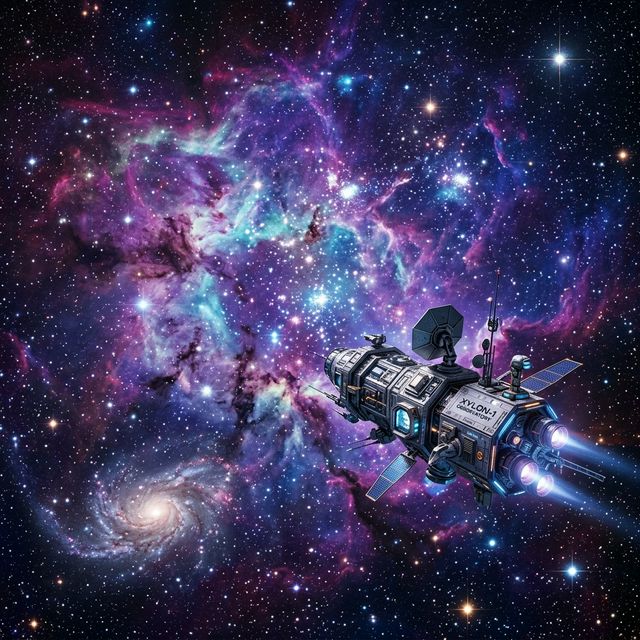
In 2019, the Event Horizon Telescope captured something once thought impossible: an actual image of a black hole's event horizon. Located at the center of the M87 galaxy, this massive object confirmed Einstein's theories in a way no mathematical model ever could. It wasn't just a discovery; it was a visual proof of the universe's most extreme physics.
2. The Giant Nebula Secrets

New infrared telescopes have allowed us to peer through the dust of massive nebulas, revealing the birth of stars in unprecedented detail. We now know that these "stellar nurseries" are far more chaotic and dynamic than we previously imagined. The interaction of gravity and radiation in these clouds is what creates the elements necessary for life itself.
3. Water on Mars: The Search for Life
Once thought to be a bone-dry desert, we now have definitive evidence of liquid water on Mars. Whether it's seasonal flows of salty brine or massive underground lakes, the presence of water dramatically changes the probability of finding ancient or even current microbial life. Mars is no longer a dead world—it’s a hibernating one.
4. The Face on Mars: Debunked
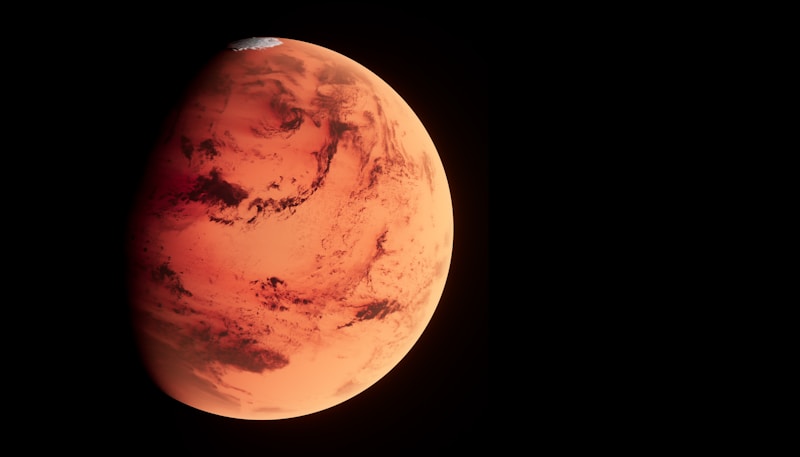
In 1976, the Viking 1 orbiter captured an image that appeared to show a giant human-like face on the Martian surface. For decades, it fueled conspiracy theories about ancient Martian civilizations. In 2001, NASA's Mars Global Surveyor captured a high-resolution image of the same region, showing it was just a natural rocky mesa—a classic case of pareidolia, where the brain sees patterns where none exist.
5. The "Wow!" Signal: A Natural Explanation?
In 1977, a strong narrowband radio signal was detected by the Big Ear radio telescope. It bore all the hallmarks of a non-terrestrial origin. While it was never detected again, recent research suggests it may have been caused by two passing comets whose hydrogen clouds emitted the signal—a natural, though highly coincidental, event that mimics an artificial signal.
6. Is Pluto a Planet? The Final Vote
The "mystery" of Pluto's status was "solved" in 2006 when the IAU redefined what a planet is. Pluto failed to "clear its neighborhood" of other debris. While it's now a "dwarf planet," NASA's New Horizons mission revealed a complex, geologically active world with mountains made of water-ice, keeping its status debated among many enthusiasts and scientists alike.
7. Exoplanets: Earth 2.0?
The discovery of thousands of exoplanets has solved the mystery of whether our solar system is unique. We now know that almost every star in the sky likely has planets. Discovering Earth-sized worlds in the "habitable zone" of their stars suggests that life may be common throughout the universe, rather than a cosmological accident.
8. The Origin of the Moon
For centuries, we didn't know where the Moon came from. The mystery was largely solved by the GIant Impact Hypothesis, which suggests a Mars-sized object named Theia collided with the early Earth. The resulting debris coalesced to form the Moon. Moon rock samples from the Apollo missions confirmed this relationship between Earth and Moon chemistry.
9. Dark Matter: The Invisible Glue
Astronomers noticed that galaxies were spinning faster than they should be based on visible matter. The mystery was solved (partially) by the discovery of Dark Matter—an invisible substance that provides the gravitational glue for the universe. While we still haven't "seen" it, its effects on the cosmos are undeniable and measurable.
10. Oumuamua: The Interstellar Visitor
In 2017, the first known interstellar object passed through our solar system. Oumuamua's strange shape and non-gravitational acceleration sparked debates about its origin. While some suggested artificial origins, most scientists agree it was a unique type of comet or a fragment of a planetary body from another star system—our first visitor from the deep cosmos.
FeexHub's Take
At FeexHub, we believe space is a vast puzzle, and every "solved" mystery just opens the door to ten more. While we find the answers eventually, the journey of looking for them is what defines our species. Whether it's a mesa on Mars or a signal from the stars, our desire to search for meaning in the cosmos is what will eventually take us to the planets we now only see through telescopes. The answer is indeed out there, and it's more beautiful than we imagined!